

Climate Crisis Becomes a Burden on the People, Government Must Make Systemic Changes
Jakarta, 17 September — The government must make systemic changes to achieve a just energy transition and transparent climate financing. This is because the national economic structure, which is heavily dependent on the extractive sector, actually exacerbates the impact of the climate crisis on society, rather than improving welfare.
Galau Muhammad, a fiscal researcher at CELIOS, emphasized that until now, Indonesia's economic structure has not reflected the government's promise to achieve net zero targets. In fact, the largest proportion of Indonesia's economic structure comes from extractive sectors, such as fossil fuels and other mining, which have a negative impact.
This is reflected in the nickel downstreaming policy that the government continues to promote. This policy is claimed to generate significant benefits for the national economy, particularly in boosting economic growth. In fact, only 20% of the profits generated from mineral downstreaming are included in tax revenues. Not only that, the presence of mineral mines and smelters has actually caused poverty in the surrounding areas to surge.
Then, deforestation spread further in the name of energy security and food self-sufficiency. In fact, the energy security promoted by the government—such as biomass co-firing and 40% biodiesel (B40)—is only a false solution to energy transition because it continues the use of coal and other fossil fuels, in addition to exacerbating the climate crisis.
"We must not pursue 8% economic growth at the expense of large-scale deforestation. In fact, meeting the B40 target will lead to a shortage of cooking oil, while around 20 million hectares of land have the potential to be converted into energy crop plantations for biomass, B40 palm oil, bioethanol, and food crops controlled by large conglomerates," said Galau.
As a result, according to CELIOS findings, there is a significant economic imbalance. Currently, the 50 richest people in Indonesia who control the extractive sector have a combined wealth of up to Rp 4.54 trillion. This has led to calls for aggressive taxation of the wealthy as a way to allocate funds for sustainable sectors and finance local initiatives that are worth promoting. "We should have a bigger picture for a sustainable economy," Galau added.
On the other hand, Khalisah Khalid, Manager of Public Engagement and Action at Greenpeace Indonesia, revealed that the impact of the climate crisis often becomes a burden that is entirely borne by the community. Not only that, the impact of the climate crisis has disturbed the sense of security as citizens.
"There are also losses suffered by the people, for example when we are sick or when we are displaced due to a disaster. All of that is borne by the people, and not by the state. We are not yet familiar with the term climate refugees. In Indonesia, even though it is not a country in conflict, the number of refugees is quite high due to the climate crisis, for example when floods occur. This may be overlooked, but the numbers are quite large," Khalisah explained.
In fact, Khalisah emphasized that Law No. 39 of 1999 on Human Rights states that everyone has the right to life, security, and a good living environment.
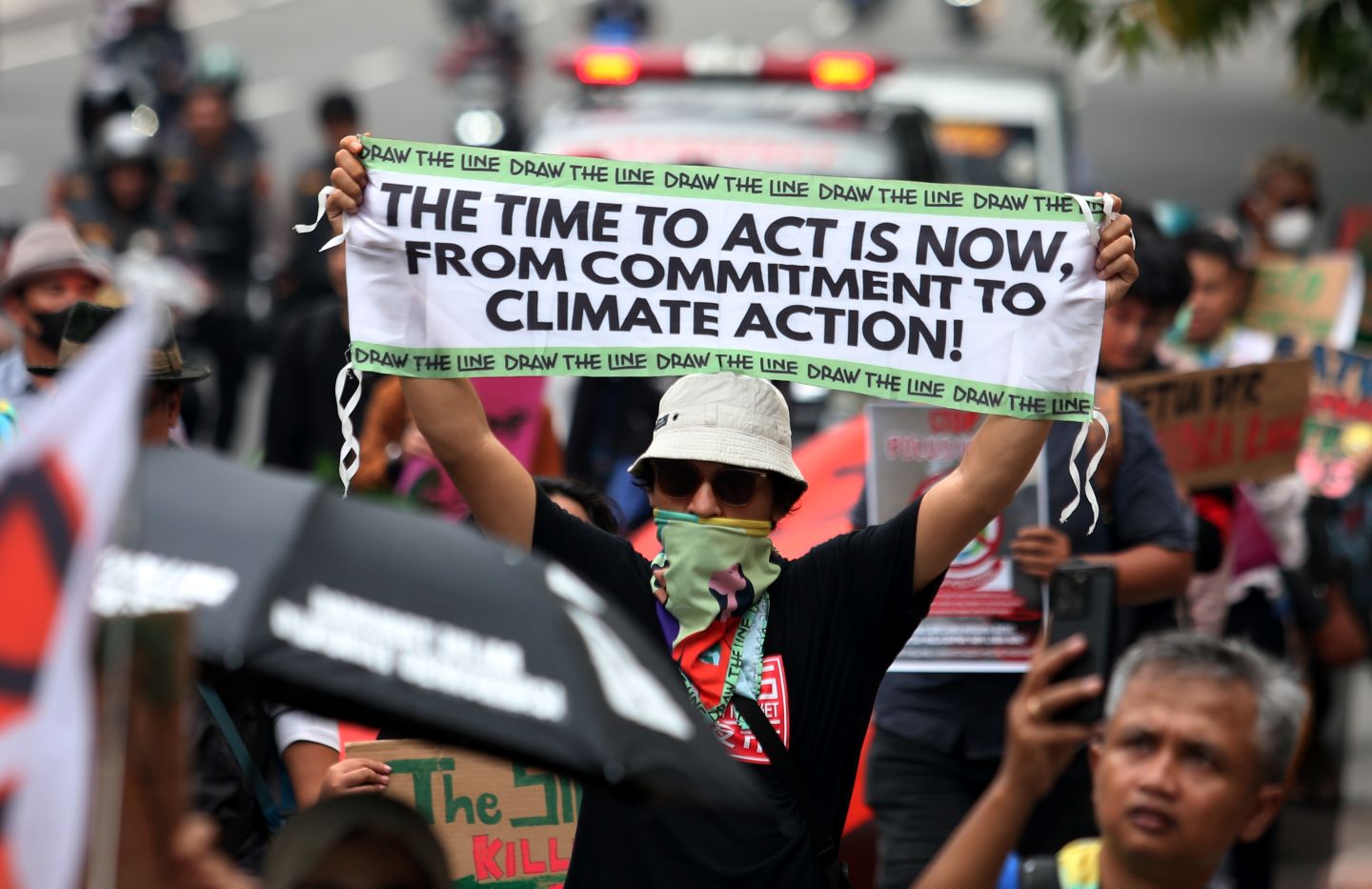
These conditions prompted a coalition of civil society organizations to initiate the Draw The Line movement, which demands climate justice through systemic change. Draw The Line asserts that climate justice is not just a matter of emissions, but also ensuring protection for vulnerable groups, transparent climate financing, and an energy transition that truly favors the people.
Indonesia actually has great potential to lead the transition to clean and equitable energy. Unfortunately, dependence on fossil fuels and government policies exacerbate inequality, stifle democracy, and ignore the voices of indigenous peoples and marginalized groups. Therefore, Draw The Line also demands that the government immediately stop funding dirty energy and redirect subsidies to equitable, community-based renewable energy.
"Climate policy must be based on the principle of justice, ensuring distributive justice for vulnerable groups. Responsibilities need to be differentiated according to each party's capabilities, while also being directed towards equitable welfare and poverty alleviation," Khalisah emphasized.
The Draw The Line action will take place on Friday, September 19, 2025, at 1:00 p.m. WIB, with meeting points at the Kendal Tunnel, Sudirman Station, and the action point at the State Palace. This action promotes the concept of "Dress Up, Show Up, Speak Up," where costumes and creative expressions become symbols of resistance and demands for real change.
"Right now, we are fed up with government policies that are actually causing suffering among the people, increasingly suffocating pollution, and the silencing of our friends who are fighting back. We want to turn that anger into a celebration of courage. Let's express our anger in our own unique ways, using our freedom of expression," said Ramadhan, Coordinator of ENTER Nusantara.
***
Media Contact
Khalisah Khalid, Public Engagement and Actions Manager Greenpeace Indonesia
(+6281290400147/khalisah.khalid@greenpeace.org)
Galau D. Muhammad, Researcher Fiscal CELIOS
(+6281931225372/galau.muhammad@celios.co.id)
Ramadhan, Action Coordinator ENTER Nusantara
(+628883455857/ramadhan@enternusantara.org)
Share Article: